Re-establishing Control Integrity in SAP Firefighter Log Reviews
- By Raghu Boddu - SAP Security & GRC Advisor | Co-Founder, ToggleNow | Author, SAP Press
Raghu Boddu also serves as a Board Member at Access Governance Inno Labs. This review is based on independent professional observations, implementation experience, and operational analysis of SAP Firefighter review processes.
The views expressed in this article are solely those of the author and do not represent sponsored content or the editorial position of SAPSecurityExpert.com.
The Structural Weakness in Firefighter Log Reviews
Firefighter (Emergency Access) log review is positioned as a critical detective control within SAP access governance frameworks. It is expected to validate whether elevated access was used appropriately, within the bounds of approved business need, and without introducing risk to financial or operational integrity.
However, in most enterprise environments, this control operates under significant structural limitations.
Controllers are required to review logs that present transaction-level activity, technical execution traces, and timestamps, without sufficient business context, without prioritization of risk, and without any systematic interpretation of what constitutes abnormal or excessive usage. As the volume of logs increases, the ability to perform meaningful analysis declines proportionally.
In practical terms, controllers often spend less than a minute per log while being expected to validate unrestricted access usage. At the same time, more than 70% of Firefighter logs typically carry no actionable risk, yet consume the majority of review effort.
The issue is not whether reviews are performed but whether they are capable of detecting misuse or anomalous behavior.
At scale, the answer is often NO .
Observations from Enterprise Implementations
During my work and closer examination of how Firefighter controls operate in practice reveals patterns that are difficult to ignore.
In one environment, Firefighter logs accumulated over extended periods and were subsequently reviewed in bulk shortly before audit. While the control appeared complete from a documentation standpoint, the timing of the reviews raised fundamental concerns regarding their effectiveness. The evaluation of risk was deferred, not performed when the activity actually occurred.
In another case, the control was effectively bypassed through automation. A custom-developed program systematically closed all pending Firefighter logs at the end of each week, inserting standardized comments under the controller’s identity. The logs reflected completion, but there was no evidence of review, analysis, or decision-making.
Further analysis across environments often reveals similar indicators - uniform comments across multiple logs, clustered closure timestamps, and a lack of correlation between activity and review timelines.
These are not isolated failures. They are predictable outcomes of a control model that relies entirely on manual effort without enabling structured evaluation.
Why Manual Reviews Fail to Provide Assurance
Manual Firefighter log reviews are inherently transaction-centric. Controllers evaluate what was executed, but they lack the ability to assess whether the execution was expected, justified, or anomalous in the broader context of user behavior.
Without this contextual layer:
- High-risk activities may appear routine
- Repeated or excessive use of Firefighter IDs may go unquestioned
- Deviations from normal user behavior remain undetected
The control becomes dependent on individual judgment, time availability, and audit pressure rather than on a consistent and enforceable evaluation framework.
From an audit perspective, this creates a critical gap. The presence of approvals does not demonstrate that risk has been assessed. Increasingly, auditors are not satisfied with evidence that logs were reviewed - they expect clarity on how risk was evaluated and why specific activities were deemed acceptable.
At this point, the control no longer mitigates risk - it only creates audit evidence.
FF Trust: Shifting from Transaction Review to Behavioral Evaluation
FF Trust introduces a fundamentally different approach to Firefighter log review by embedding AI based rules and behavioral analysis into the control itself.
Instead of presenting raw logs for manual interpretation, the solution evaluates each log against multiple dimensions before it reaches the controller. These include the frequency of Firefighter ID usage, the nature and sensitivity of executed activities, deviations from established user behavior patterns, and alignment between the original access request and actual system usage.
This approach transforms the review process from a transactional inspection into a contextual evaluation.
Logs that do not exhibit risk characteristics are automatically classified and closed, while logs that demonstrate deviations or anomalies are escalated with a structured synopsis. Controllers are no longer required to interpret raw data; they are provided with a pre-analyzed view that highlights areas requiring attention.
This ensures that every log is evaluated, not just those that receive manual focus.
Comparative View: Manual Reviews vs FF Trust
| Aspect | Manual Firefighter Log Reviews | FF Trust AI-Driven Evaluation |
|---|---|---|
| Detailed Analysis | Performed selectively, depending on time, volume, and perceived risk. | Applied consistently to every log through predefined evaluation logic. |
| Evaluation Approach | Transaction-level inspection without behavioral context. | Multi-dimensional analysis incorporating user behavior, frequency, deviation, and intent alignment. |
| Consistency of Outcomes | Varies significantly across controllers and review cycles. | Standardized evaluation framework ensures uniform outcomes. |
| Handling of Volume | All logs require manual attention, leading to superficial reviews at scale. | Low-risk logs are automatically closed; human attention is reserved for exceptions. |
| Control Timing | Often retrospective, influenced by audit cycles and backlog clearance. | Continuous and aligned with actual usage patterns. |
| Exposure to Bypass | Susceptible to operational workarounds and superficial closure practices. | Evaluation logic embedded within the system reduces bypass risk. |
| Audit Defensibility | Demonstrates completion of review. | Demonstrates structured assessment of risk with traceable rationale. |
Case Insight: Large-Scale SAP Landscape (10+ Systems, ~20,000 Users)
The solution was implemented in a complex enterprise environment with more than 10 SAP systems and approximately 20,000 active users. The landscape generated a high volume of Firefighter usage across business and IT operations, making manual review increasingly difficult to sustain with consistency.
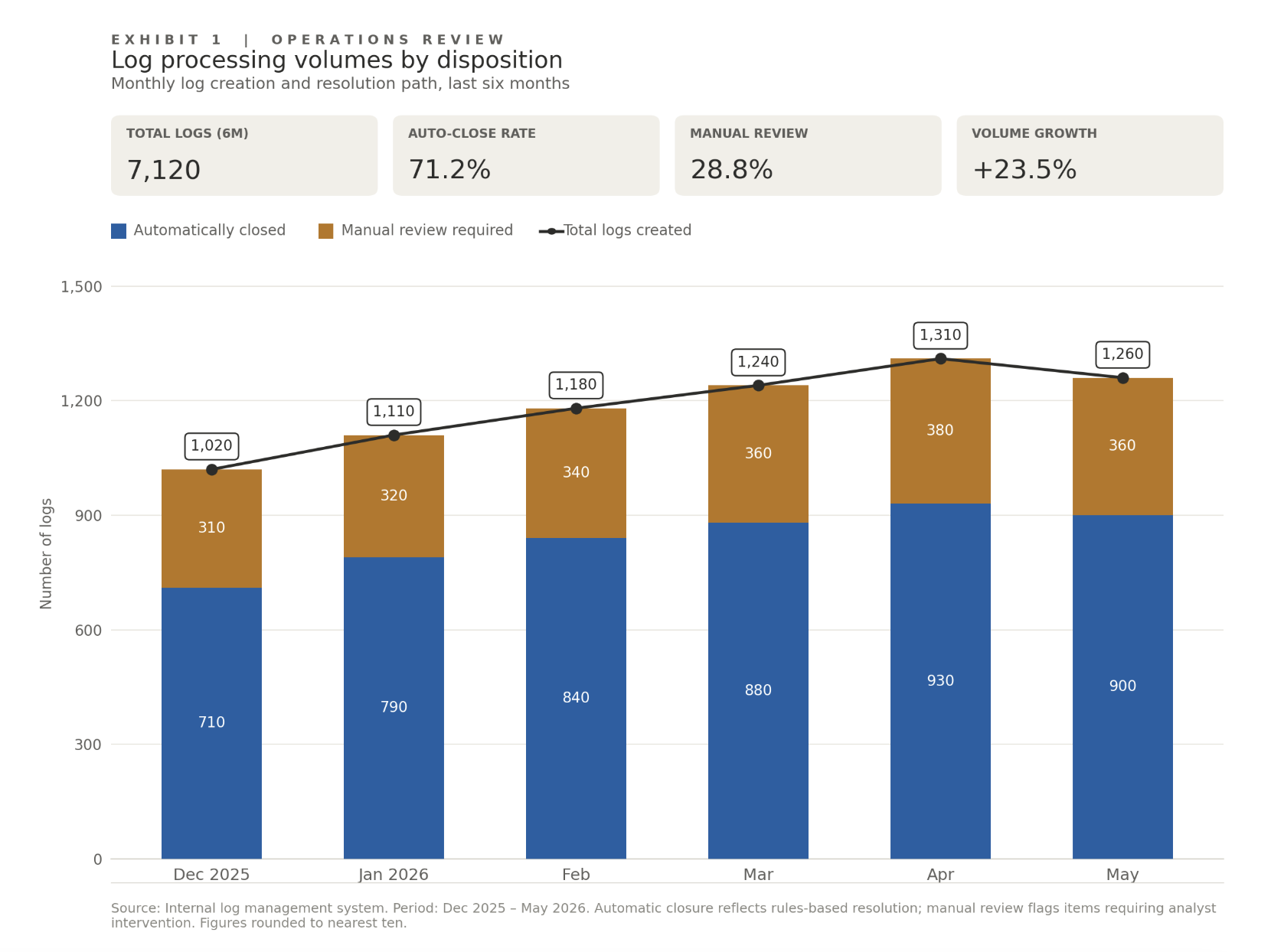
Prior to implementation, the organization faced typical challenges - high log volumes, inconsistent review quality, and significant controller effort with limited assurance on actual risk evaluation.
Following the implementation of FF Trust, the outcomes were measurable.
Approximately 70% of Firefighter logs were automatically reviewed and closed based on rule-driven and behavioral evaluation. The remaining logs were enriched with a structured synopsis directly within the review workflow, providing clear context on activity, intent alignment, and potential risk indicators(1). This enabled controllers to focus only on exception scenarios, reducing review effort while improving the quality of decisions.
The outcome was not limited to efficiency gains. It established a consistent and evidence-backed review model, where every log was evaluated systematically and every decision could be explained.
At this scale, manual review is not inefficient - it is unreliable.
(1) Added in the newer release
What This Means for Control Effectiveness
The distinction between manual reviews and FF Trust is not incremental - it is foundational.
Manual reviews operate at the level of individual events, attempting to interpret isolated transactions without sufficient context. FF Trust evaluates behavior across time, identifying patterns that indicate whether access usage aligns with expected norms or introduces potential risk.
This shift enables organizations to move from a model where controls are performed to one where controls are effective, measurable, and defensible.
Final Assessment
Firefighter log review has, in many organizations, evolved into a control that is operationally completed but not substantively effective. The limitations of manual review are not a reflection of capability but of design - human-driven processes cannot sustain the level of analysis required at enterprise scale.
FF Trust addresses this gap by embedding intelligence, consistency, and behavioral context directly into the review process. It ensures that evaluation is not dependent on individual effort, timing, or interpretation, but is systematically applied across all privileged access activity.
In doing so, it restores the control to its intended purpose: validating that elevated access is used appropriately, and identifying where it is not.
Because ultimately, in privileged access environments, the risk does not lie in isolated transactions. It lies in patterns of behavior that remain unexamined.