Practical AI Integration for SAP Security
SAP environments generate far more security signal than most Basis teams can process manually. This guide walks through a modular, scalable architecture for closing that gap using modern data pipelines and AI.
Architecture Mindset
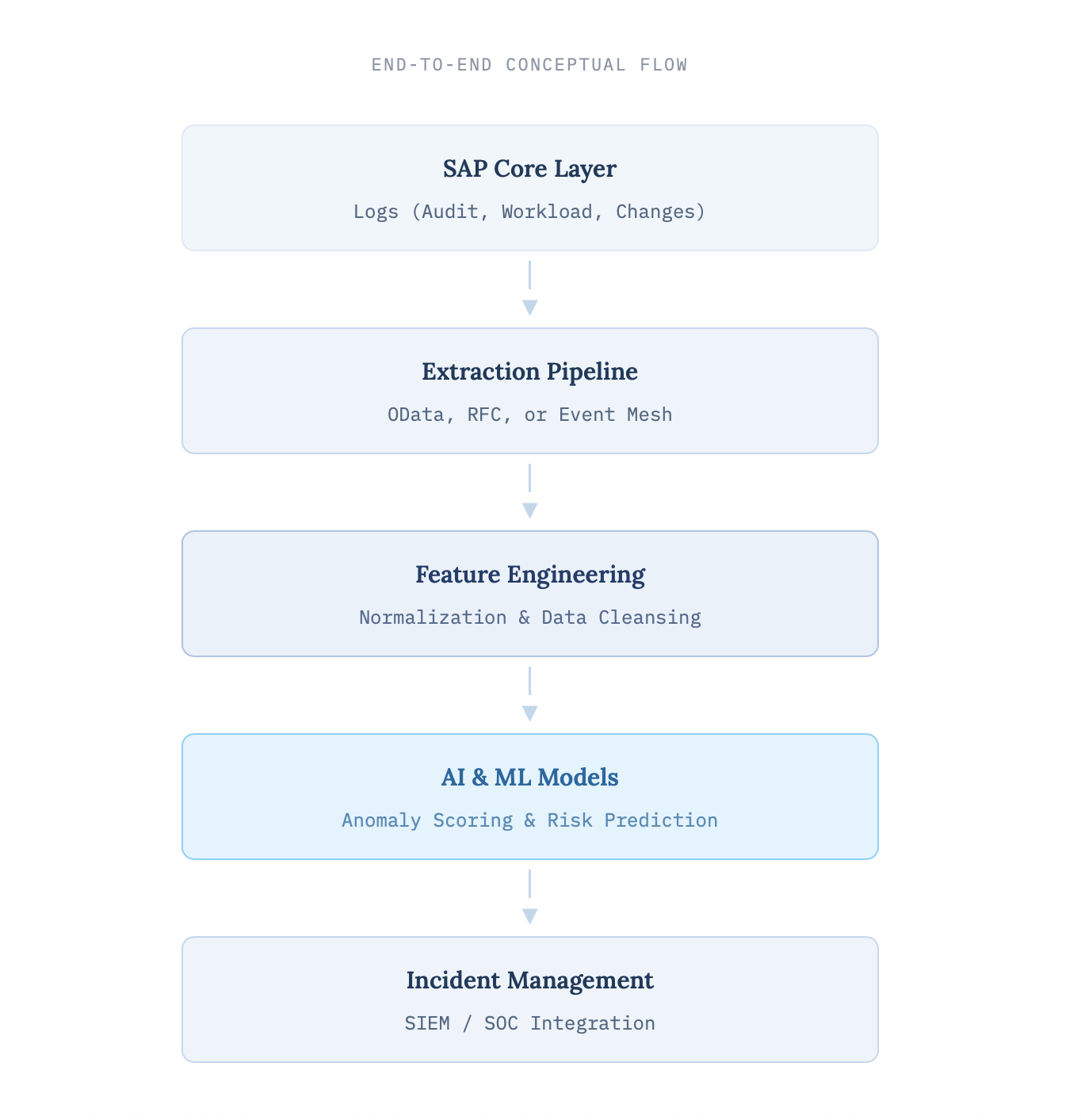
The guiding principle is straightforward. SAP is the authoritative data source, but it is not the right environment for heavy-duty analytics. Running intensive machine learning directly inside the ABAP stack introduces real performance risk. The better path is to move that data into a purpose-built environment - a cloud ML platform or a data lake, and feed only the resulting risk scores back into the security ecosystem.
This modular approach preserves SAP core stability while giving the security team access to modern tooling. It is the architecture that meaningfully reduces Mean Time to Detect without creating anxiety for the Basis team over system resources.
Where Logs Live
Locating the right signal is often half the challenge. Within the SAP landscape, four areas offer the richest context for training and running security models.
User Behavior (STAD)
The workload tables STAD and ST03N are essentially a fingerprint of system activity. They record which T-codes were executed and by which users. Building a reliable behavioral baseline from this data is what makes downstream anomaly detection viable.
The Change Audit
Tables CDHDR and CDPOS record every modification to master data objects. When a vendor's banking details are updated outside of a formal change request, these tables hold the only evidence trail. For any fraud detection use case, they are non-negotiable data sources.
Access Metadata
The USR* and AGR* table families describe the full authorization landscape - who holds which roles and what those roles permit. Pulling this data allows the model to detect unexpected privilege escalation or role assignment anomalies.
The Security Audit Log (SM20)
The classic security log captures failed authentication attempts and sensitive RFC activity. A critical prerequisite: confirm that the relevant audit classes are active in SM19. An unconfigured log profile means the model trains against silence.
Pulling the Data
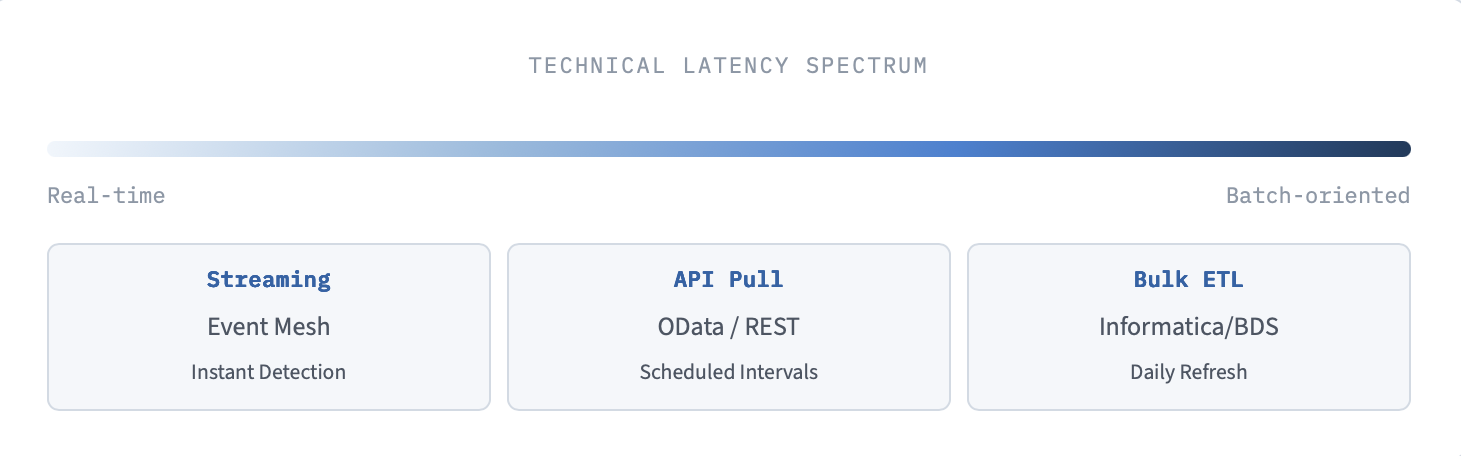
Extraction strategy is about more than data movement. It is about doing it safely and the right approach depends on what detection latency the security program actually requires, and what infrastructure already exists.
The Feature Layer
Raw SAP tables are not model-ready. Feeding a raw USR02 extract directly into a classifier will not produce meaningful results. The critical step is transforming table data into risk-representative features by moving from raw timestamps to derived signals like "Activity Outside Contracted Hours" or "Deviation from Peer Group Baseline."
Model Selection
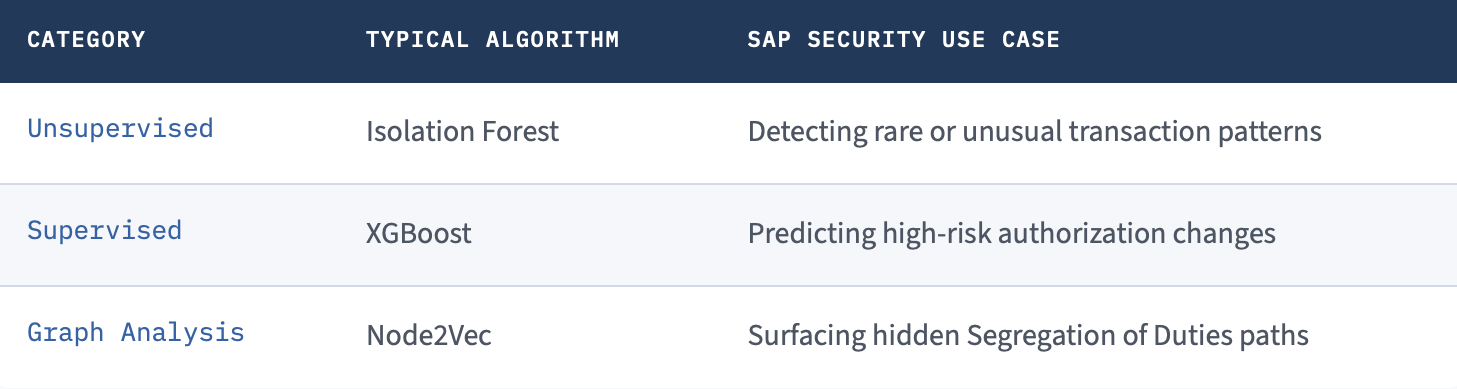
Complex models are not always superior. For most SAP security applications, interpretable models deliver more practical value because regulated audit environments demand explainability not just accuracy.
SIEM Workflows
The AI model's responsibility is not remediation but rather it gives the SOC analyst a well-reasoned basis for investigation. This is accomplished by forwarding a structured JSON payload to the SIEM platform (Sentinel, Splunk, or equivalent). The payload carries the User ID, a numerical risk score, and a human-readable summary of what triggered the alert.
Response Strategies
When the model surfaces a risk signal, the response must be calibrated to the severity. Actions fall into two clear categories: those that execute automatically and those that require a human decision before anything changes.
Human Intervention
- Manager review of flagged activity
- Manual account lock for privileged users
- Detailed forensic investigation
Automated Guardrails
- Revoking emergency access credentials
- Triggering step-up MFA re-authentication
- Isolating specific RFC service users
Batch vs. Streaming
Most production architectures reflect a deliberate trade-off between detection speed and operational cost. Understanding both tracks clearly is essential before committing to either.
Batch Processing (Standard)
A scheduled ETL or OData pull running every 24 hours. Low operational overhead, straightforward to debug, and entirely sufficient for SoD conflict analysis, access certification, and compliance reporting.
The trade-off is detection lag. An incident occurring at 09:00 may not surface until the following morning's pipeline run.
Streaming Processing (Advanced)
SM20 events forwarded to a Kafka topic via SAP Event Mesh or a dedicated log agent. A stream processor like Flink or Spark Streaming applies lightweight scoring and writes results to the SIEM within seconds. Sub-minute detection latency is a realistic target.
The infrastructure cost is proportionally higher. Schema evolution, stateful processing, and consumer lag monitoring are ongoing operational concerns that the batch path sidesteps entirely.
Start with the batch pipeline. It delivers roughly 80% of the security value at a fraction of the operational burden. When streaming becomes a genuine requirement, the transition is additive, the same feature definitions and model artifacts carry forward. Only the data transport changes.